






The ubiquitous "sensory organ": How sensors are quietly changing our world
Have you ever imagined that as you approach the mall entrance, the door opens automatically; when the indoor light dims, the streetlights turn on quietly; and when the kitchen fills with smoke, the alarm sounds a sharp warning? Behind all this, tiny "electronic sensors" work silently—these are the sensors.
Today, let's take a look at the mystery of sensors and explore this ubiquitous technological cornerstone.
1. What is a sensor?
Simply put, sensors are like electronic versions of human sensory organs. They detect and sense various signals or physical changes in the external environment and convert them into electrical signals for the device to "read" and respond to.
Eye-> Light sensor: sense light intensity.
Ears-> Sound-sensitive sensor: captures sound vibrations.
Skin-> Temperature/pressure sensor: sense heat and pressure.
Nose-> Gas sensor: Identify specific gas components.
It is these ever-changing "electronic senses" that give the cold machine the ability to perceive the world.
II. The Sensor Family: The Core Members Around Us
There are many types of sensors, and here are some of the most common "members" of our daily lives:
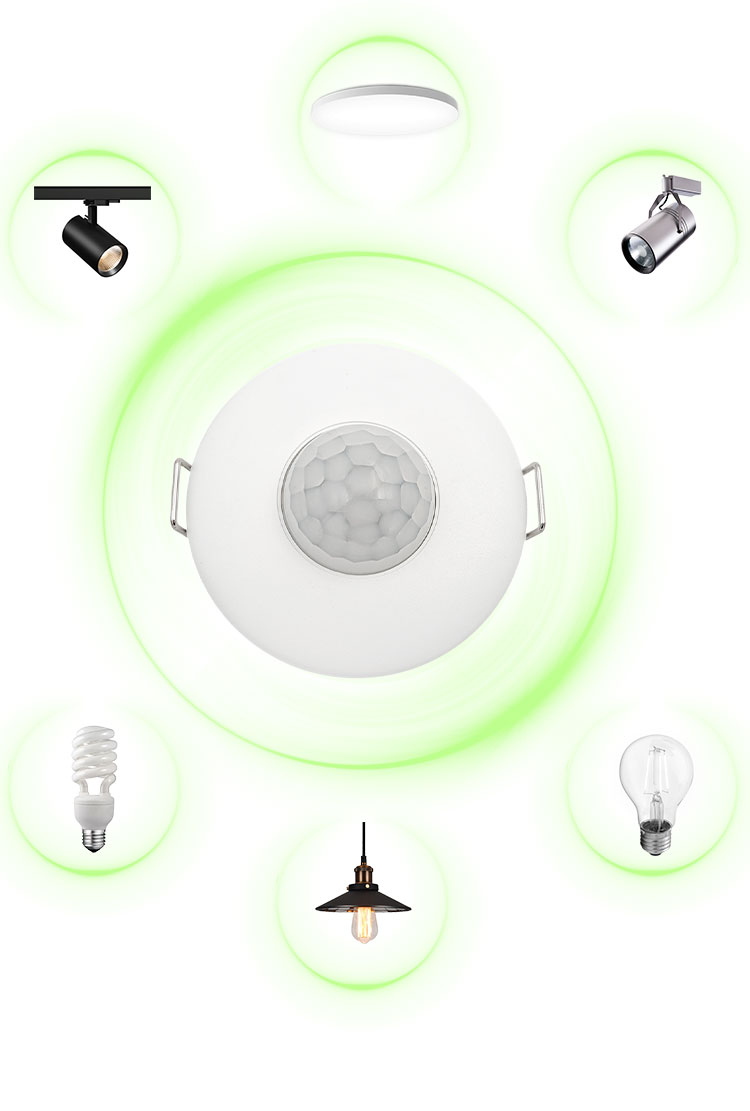
Motion sensor
1. Working principle: It mainly detects moving infrared radiation (passive infrared, PIR), ultrasonic echo changes or microwave Doppler effect.
Application scenarios: automatic door, security alarm system, automatic lighting of smart home.
temperature sensor
1. Working principle: Measurement is made by the characteristic of resistance or voltage of components with temperature change.
Application scenarios: air conditioning temperature control, smart phone battery temperature management, smart refrigerator, weather station.
light sensor
1. Working principle: using photoresistor and other components, the resistance value will change with the intensity of light.
Application scenarios: mobile phone screen automatic brightness adjustment, street light automatic switch, solar street light.
Distance/Proximity sensor
1. Working principle: Infrared or ultrasonic waves are usually used to calculate the distance by transmitting and receiving the reflected signals.
Application scenarios: automatic screen dimming when answering calls on smartphones, car reversing radar, and obstacle avoidance for drones.
imaging sensor
1. Working principle: the core of converting optical images into electronic signals is thousands of photosensitive units.
Application scenarios: mobile phone/camera photography, face recognition access control, industrial quality inspection.
Gas/smoke sensor
1. Working principle: When a specific gas (such as smoke, carbon monoxide, formaldehyde) is detected, its electrical conductivity or other physical properties will change.
Application scenarios: home smoke alarm, air quality detector, drunk driving detection.
III. From "automation" to "intelligent": The core value of sensors
The role of sensors is much more than making life "more convenient", it is the cornerstone of automation and intelligence.
Improving efficiency and convenience: factory robots rely on vision and force sensors to assemble with precision; home robots use a combination of sensors to clean autonomously.
Protecting safety and health: Tire pressure monitoring and airbag collision sensors in cars can protect lives in critical moments; heart rate and blood oxygen sensors in wearable devices can protect our health.
Driving data and decision-making: In smart agriculture, soil moisture sensors collect data to guide precision irrigation; in urban management, traffic flow sensors provide the basis for optimizing traffic light timing. These massive amounts of data are the 'food' for artificial intelligence to make optimal decisions.
IV. Future Outlook: Smaller, Smarter, More Integrated
Sensor technology is evolving rapidly, and the future trends are clear:
Miniaturization and integration: Sensors are getting smaller, consuming less power, and integrating multiple sensing functions on a single chip.
Intelligence: In the future, sensors will not only be responsible for "collecting" data, but also have the ability to "process" and "judge" locally, and edge computing will become standard.
The rise of biosensors: Noninvasive, implantable biosensors that can monitor more complex physiological indicators (such as blood sugar, stress levels) will become the core of digital health.
epilogue
Sensors, these seemingly tiny electronic components, have become the bridge connecting the physical world with the digital realm. They grant machines "perception," transforming our environment into an interactive and responsive space. Next time a door opens for you or a light illuminates, remember to thank the silent sensors working behind the scenes – they form the fundamental sensory cells that create our intelligent future.
Related Posts